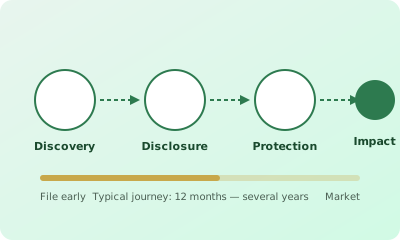
Five stages that move your research from discovery to real-world use. Each stage has its own tools, decisions, and support — you don't have to navigate it alone.
Before You Start
Technology transfer is a process that can take months to years. The trail metaphor is intentional: some stages are quick and straightforward; others require patience, iteration, and a willingness to pivot.
The most important thing you can do is start early — before you publish, present at a conference, or share your work publicly. Once a disclosure is public, patent eligibility in most jurisdictions is lost within 12 months (or immediately in some countries).
Key rule: Contact UVM Innovations before any public disclosure. Reach out at innovate@uvm.edu or submit an Invention Disclosure Form as soon as you think you have something.
What This Trail Covers
| # | Stage | Key Action |
|---|---|---|
| 1 | Research Meadow | Fund & conduct R&D |
| 2 | Supply Shop | File Invention Disclosure |
| 3 | Advancement Trails | Prototype & develop |
| 4 | Market Meadow | Validate & plan |
| 5 | Mountain Summit | License, launch, or release |
Stage by Stage
Every transfer starts here — in the lab, the field, or the studio. This stage is about conducting strong, fundable research and documenting your work carefully. Good lab notebooks and clear records are the foundation of any IP claim.
This is the most critical and time-sensitive stage. Once you believe you have a potentially patentable invention, you must disclose it to UVM Innovations before any public release. This protects your right to file for patent protection and keeps all pathways open.
Why file early? The US uses a "first to file" system — not first to invent. Filing a provisional patent application secures your priority date for 12 months at relatively low cost, giving you time to further develop and assess the technology.
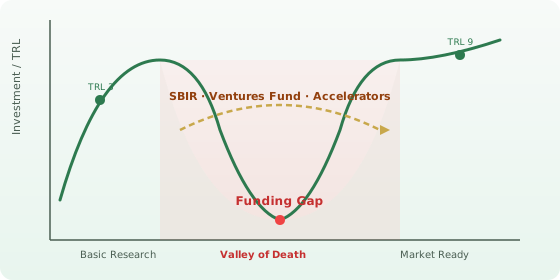
A patent or disclosure is not a product. This stage is about moving from proof-of-concept toward something demonstrable — a working prototype, a validated algorithm, a tested device. Industry partners and investors need to see evidence that it works.
| TRL | Description |
|---|---|
| 1–3 | Basic research, proof of concept |
| 4–5 | Lab prototype validated |
| 6–7 | Prototype demonstrated in relevant environment |
| 8–9 | System proven, ready for commercialization |
Technical success and commercial success are different things. This stage is about understanding who your technology serves, whether they will pay for it (or use it), and what it takes to reach them. Customer discovery is the core skill here.
You've validated your technology and your market. Now it's time to formalize the relationship between your innovation and the world. This looks different depending on your pathway.
Common Questions
Under UVM's IP policy, inventions made using UVM resources, funding, or within the scope of your employment or research affiliation are generally owned by the University. However, UVM shares royalties with inventors — typically the inventor(s) receive a significant percentage of net licensing revenue. Students may have more flexibility, especially for inventions developed independently. Talk to UVM Innovations early to clarify ownership before it becomes a problem.
Yes — but you must file at least a provisional patent application before public disclosure to preserve rights in most countries. In the US you have a 12-month grace period after disclosure, but many international jurisdictions require filing before any public disclosure. Submit your Invention Disclosure to UVM Innovations at least one month before submitting a paper, presenting at a conference, or posting a preprint.
The "Valley of Death" is the gap between a laboratory-validated technology (TRL 3–4) and a product that a company can deploy or sell (TRL 7+). Most technologies die here because they need engineering, testing, regulatory work, and capital that academic labs don't have. SBIR/STTR grants, the UVM Ventures Fund, and accelerator programs are specifically designed to help researchers bridge this gap without giving up equity prematurely.
Open-source release is a legitimate and recognized technology transfer outcome. UVM Innovations can help you select an appropriate license, formally release the IP, and ensure proper attribution. Open-source release can also strengthen your academic reputation, build a user community, and sometimes attract commercial partners who want supported versions.
Absolutely. The ARC (Academic Research Commercialization) program was specifically designed to involve students in the commercialization process. Students can also participate in NSF I-Corps teams (as the entrepreneurial lead), apply for ORCA research funding, and engage with SPARK-VT. If you developed something as part of your dissertation research, talk to your advisor and UVM Innovations about your options.